
Terraria: Otherworld Is Still a Ghost in 2026, and I’ve Made Peace With It
Terraria: Otherworld cancellation remains a captivating sandbox gaming mystery, influencing Terraria's evolution and fan nostalgia.
As a regular player who has poured hundreds of hours into Terraria since the early 1.2 days, I still catch myself staring at the old Otherworld logo like a kid pressing his nose against a locked toy store window. The image is burned into my memory—a promise of an alternate Terraria universe that never quite made it out of the workshop. In 2026, the cancellation of Terraria: Otherworld remains one of the most fascinating “what ifs” in modern sandbox gaming, and I want to unpack why it still resonates.
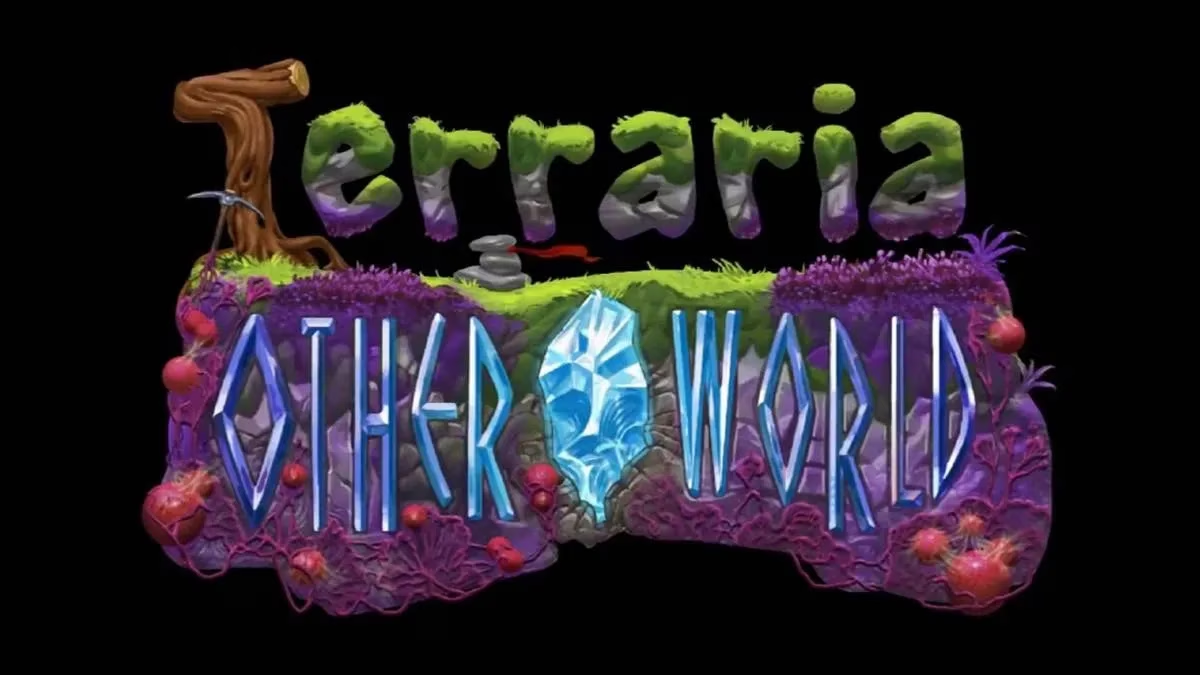
The spin-off was first teased in February 2015 via Re-Logic's YouTube channel and then given a fuller reveal at the 2015 Game Developers Conference. According to Re-Logic and then-developers Engine Software, Otherworld was not just Terraria with a fresh coat of paint. It was set in an alternate dimension within the Terraria universe and followed a band of survivors trying to stop a malevolent, nature-corrupting force. The pitch included deeper role-playing and strategy systems: skill trees, special Purifying Towers, and a more structured campaign. To me, it sounded like Re-Logic wanted to take the chaotic joy of Terraria and run it through a more deliberate, almost tactical sieve.
Then came the silence. A forum post in 2018 officially pulled the plug. Re-Logic admitted, “we have to be honest with ourselves and realize that Otherworld simply is never going to reach its potential in any sort of reasonable time or fashion.” That line still hits hard. The developers also owned their mistakes, talking openly about the dangers of outsourcing development and announcing projects too early. The project became a fossil preserved in amber—gorgeous in concept, but stripped of any chance to breathe.
Looking back, the cancellation was not a funeral pyre so much as a controlled burn. By clearing away the underbrush of a troubled spin-off, Re-Logic gave the main Terraria tree more room to grow. I won't pretend it didn't hurt; I had spent years hoping for a new dimension to explore. But the lessons clearly fed back into the core game.
Some of Otherworld's DNA may have quietly slipped into Terraria's Journey's End update, which arrived in 2020 to celebrate the game's ninth anniversary. For instance, the teleportation Pylons introduced in Terraria 1.4 look somewhat similar to the constructible towers from Otherworld. There is no official confirmation of a direct link, but as a fan it feels like seeing a familiar face in a crowd—you can't prove the connection, yet the resemblance is too strong to ignore. Journey Mode also arrived as a creative-style option, echoing Minecraft's creative mode and giving players a less punishing way to build and experiment. 🧱
Here is a quick timeline of the whole saga:
| Year | Milestone |
| 2015 | Otherworld teased and revealed at GDC |
| 2018 | Re-Logic officially cancels development |
| 2020 | Journey's End launches for Terraria's ninth anniversary |
| 2026 | Otherworld remains shelved, but its ideas linger |
As I write this in 2026, I have made peace with the fact that Terraria: Otherworld is never coming back. The spin-off was a lighthouse that never lit its lamp, but it still warned Re-Logic away from rocky outsourcing waters. Meanwhile, Terraria itself has continued to thrive, with Journey's End giving long-time fans and newcomers alike reasons to return. If you still crave that alternate-dimension strategy vibe, there are plenty of similar games to Terraria that can scratch the itch, but none will carry the exact weight of what Otherworld could have been. 🗼
Terraria is available now on PC, PS4, Switch, Xbox One, and various legacy devices. For me, the cancelled spin-off remains a strange kind of comfort—a reminder that even talented studios sometimes have to prune a branch so the whole tree can flourish. And honestly? I would rather have one extraordinary Terraria than two half-finished worlds.