
Terraria's Stadia Launch: A Glimmer in the Cloud Before Sunset
Terraria's Stadia release, the beloved 2D sandbox, overcame cancellation after Re-Logic's Google account ban reversal.
I still vividly recall the strange brew of emotions that swirled around the gaming community in early 2021. Google Stadia, the ambitious cloud gaming platform that had promised to unshackle us from hardware, was already gasping for relevance. The headlines were merciless: studio closures, departure of key visionaries, and a thinning games library. Yet in that atmosphere of gentle decay, a little pixel‑sized hero named Terraria appeared on the horizon, ready to make a port that felt almost quixotic.
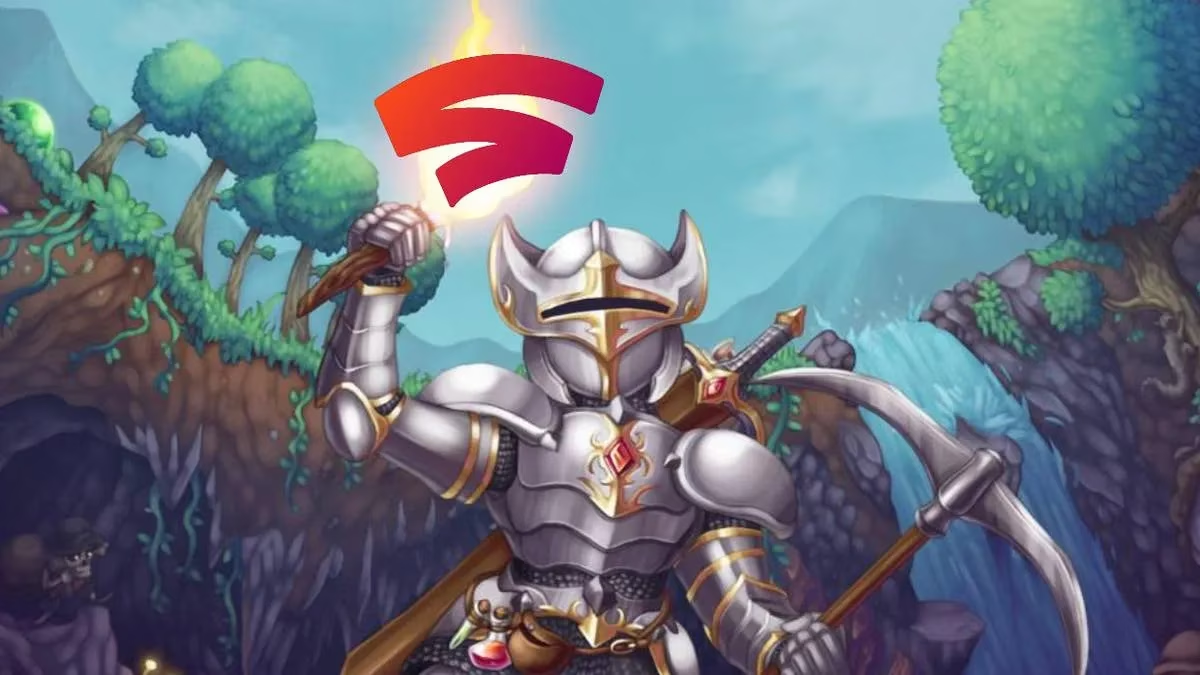
Eager beavers who had already carved out kingdoms on PC, mobile, and consoles knew Terraria as the definitive 2D sandbox adventure. The game originally hatched on Steam in 2011 and swiftly became a phenomenon — over 35 million copies sold, countless “Just one more block” nights, and a depth that rivals much flashier titles. It’s a sprawling tapestry of mining, crafting, boss‑slaying, and base‑building that feels equally at home on a high‑end rig as on a Nintendo Switch. So when the official Stadia Twitter account confirmed a release date of March 18, 2021, it felt like a small but genuine injection of hope into the platform’s weary veins.
A Portal’s Tumultuous Journey
What made the announcement particularly fascinating was the soap‑opera subplot. Just weeks earlier, Re‑Logic, the development maestros behind Terraria, had publicly revealed that the Stadia port had been outright canceled. The reason? A rather public falling out after Google suspended the developer’s entire Google account without explanation, locking them out of years of emails, documents, and vital services. In a landscape where relationships between platform holders and creators are everything, the incident felt catastrophic.
Then, faster than you can summon the Wall of Flesh, the narrative flipped. After intensive back‑channel negotiations and a public mea culpa from Google, the ban was lifted, the accounts were restored, and the Stadia port was miraculously uncancelled. The March 18 release date landed less than a month after the course correction, which told me the technical work must have already been remarkably mature. I couldn’t help but admire the resilience of both parties — a testament to how deeply the community loved the game and how desperately Stadia needed a beloved indie champion.
What Terraria Brought to the Cloud
For the uninitiated, Terraria is not just a 2D Minecraft clone. It’s a mechanically dense marvel where surface exploration quickly gives way to subterranean labyrinths filled with glowing mushrooms, cursed skulls, and ancient automatons ready to clobber you. The journey from a helpless newcomer armed with a copper shortsword to a celestial demi‑god wielding a Terrarian yo‑yo and riding a UFO is a story only you can author. Key features include:
-
🔨 Creative & destructive freedom: Every tile is malleable, allowing players to sculpt castles, arenas, and vast transportation networks.
-
🧌 Progression & NPCs: By fulfilling specific conditions, you attract dozens of quirky NPCs — from the Arms Dealer to the Party Girl — who unlock new gear, services, and a sense of a living world.
-
👾 Epic boss battles: Over 30 unique bosses encourage intricate arena preparation, potion brewing, and pattern memorization.
-
🌍 World seeds & replayability: Hidden “Easter egg” seeds — such as the “For the Worthy” seed that amplifies difficulty and reshapes the world — keep the experience perpetually surprising.
-
🎮 Multiplayer: Seamless drop‑in/drop‑out co‑op that the cloud infrastructure was built to handle with ease.
At a time when Stadia was starved for system‑selling exclusives, having a complete and content‑dense game like Terraria felt like a meaningful win. It didn’t require ray tracing or 4K 60fps benchmarks to shine; it simply needed to run smoothly and let players sink hundreds of hours into its labyrinthine depths from any screen.
The Bittersweet Aftertaste
And yet, from my vantage point in 2026, I see that March 2021 launch with a sepia‑toned wistfulness. Update 1.4.1 — proclaimed by Re‑Logic as the game’s final major content update — had already landed in October 2020. That meant the Stadia version was born into a state of perpetual completeness. No new biomes, no extra boss, no Journey’s End expansions would ever cross its threshold. The cloud version was a perfectly preserved time capsule, but it was already a memory of what the game had been rather than a vision of what it could become.
Moreover, the larger Stadia narrative was already writing its epitaph. The service would eventually shutter in January 2023, refunding all hardware and software purchases in an unprecedented (and somewhat honorable) collapse. Terraria’s Stadia release thus transformed into a poignant footnote — a flicker of vitality right before the terminal decline. Those of us who joined that pixelated world through a Chrome browser knew we were part of a transient chapter, yet the magic of mining, building, and battling felt no less real.
Final Thoughts from a Cloud Veteran
Looking back, I treasure the months I spent on Stadia Terraria. It served as a gentle reminder that gaming’s soul isn’t tethered to teraflops or silicon. A decade‑old masterpiece could still weave new memories on a struggling platform, bridging the gap between a canceled and uncancelled future. In a way, Terraria taught me that even in a digital sky filled with uncertainty, a single seed of creativity can still grow into something worth celebrating. And long after the servers went dark, those blocky, lamplit villages we dug out of the dirt still stand tall in my memory.